
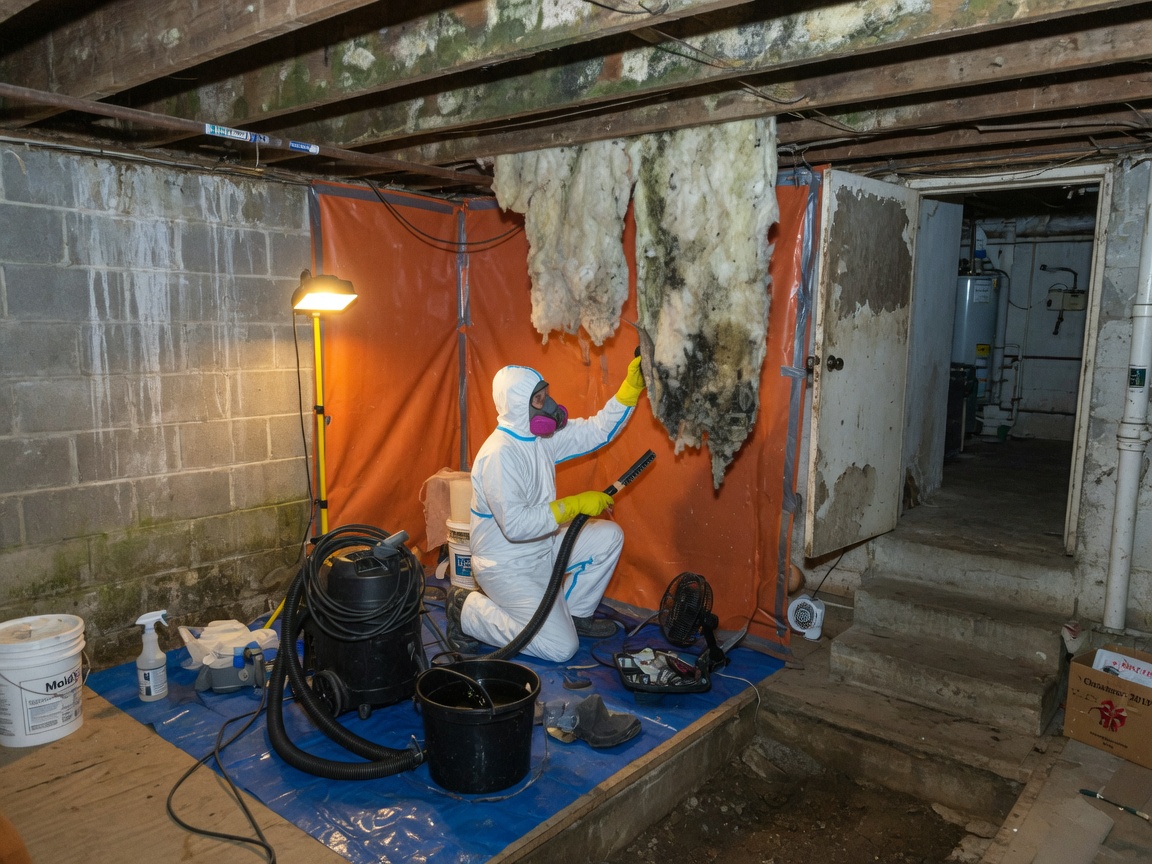
Ellerbe Woods is the newest and highest-income part of Shreveport, and the mold problems here look nothing like the ones in Highland or Cedar Grove. Along Ellerbe Road and through the subdivisions that branch off it — Huckleberry Ridge, the Ellerbe Road Estates area, the streets off Canterbury and Brittany — the housing is largely post-1980, much of it slab-on-grade, on wooded pine lots south of the city loop near Wallace Lake. Older, smaller, wetter crawl spaces are not the issue. Mechanical and envelope failures in large houses are.
Oversized Systems in Large Houses
The single most common cause of mold in Ellerbe Woods homes is an air conditioner sized for the square footage but not for the humidity. A 3,500 square foot house with a generously sized system cools to thermostat in a few minutes and shuts off — which means the coil never runs long enough to pull meaningful moisture out of the air. The house feels cool and sits at 58 to 62 percent relative humidity, and mold appears on the backs of closet walls, behind furniture against exterior walls, inside built-in cabinetry and on the underside of ductwork, with no leak anywhere in the building.
Multi-zone and dual-system homes make it worse, because a zone that rarely calls for cooling gets almost no dehumidification at all. Bonus rooms over garages and finished attic spaces are the usual first place growth shows up. The correction is rarely remediation alone — it is run-time, duct sealing, and in most of these houses a whole-house dehumidifier tied into the return.
Wooded Lots and What the Pines Do
The tree canopy that makes these lots desirable also keeps roofs and north elevations in shade, so they dry slowly after rain and stay cooler than the surrounding air. Pine needles pack gutters and valleys faster than leaves do, and a blocked valley or gutter on a large complex roofline backs water under shingles and into the sheathing. Attic mold in Ellerbe Woods is frequently a drainage problem on the roof rather than a ventilation problem in the attic.
The proximity to Wallace Lake and the Red River bottomland also matters on the lower-lying lots. Where slabs sit close to grade on ground that holds water, slab edge wicking and moisture under flooring show up without any plumbing failure — particularly where landscaping beds and irrigation have been built up against the foundation over the years.
Large homes also mean the problem is usually found later and is larger when it is. A 200 square foot patch of growth in a rarely used guest wing, bonus room or finished storage area has often been developing for a year or more. That makes early moisture mapping worth more here than anywhere else in the city — catching it as a mechanical problem costs a fraction of catching it as a reconstruction project.
Around Ellerbe Woods
We regularly work near:
- 📍Ellerbe Road
- 📍Wallace Lake
- 📍C. Bickham Dickson Park
- 📍Southern Hills Metro Park
- 📍Huckleberry Ridge
Mold Remediation in Ellerbe Woods — Local Notes
- •Predominantly post-1980 construction, much of it slab-on-grade — so moisture paths run through HVAC condensation, slab edge wicking and roof drainage rather than damp crawl space soil.
- •Oversized and multi-zone HVAC systems in large houses short cycle against Shreveport humidity, holding interiors near 60% relative humidity and growing mold with no leak present.
- •Heavy pine canopy keeps roofs and north elevations shaded and slow to dry, and packs gutters and roof valleys faster than deciduous leaves.
- •Lower lots near Wallace Lake and the Red River bottomland hold groundwater high, producing slab edge moisture where landscaping and irrigation have been built up against the foundation.
- •Rarely used bonus rooms, guest wings and finished storage mean growth often goes unnoticed for a year or more, so the job is larger by the time it is found.