
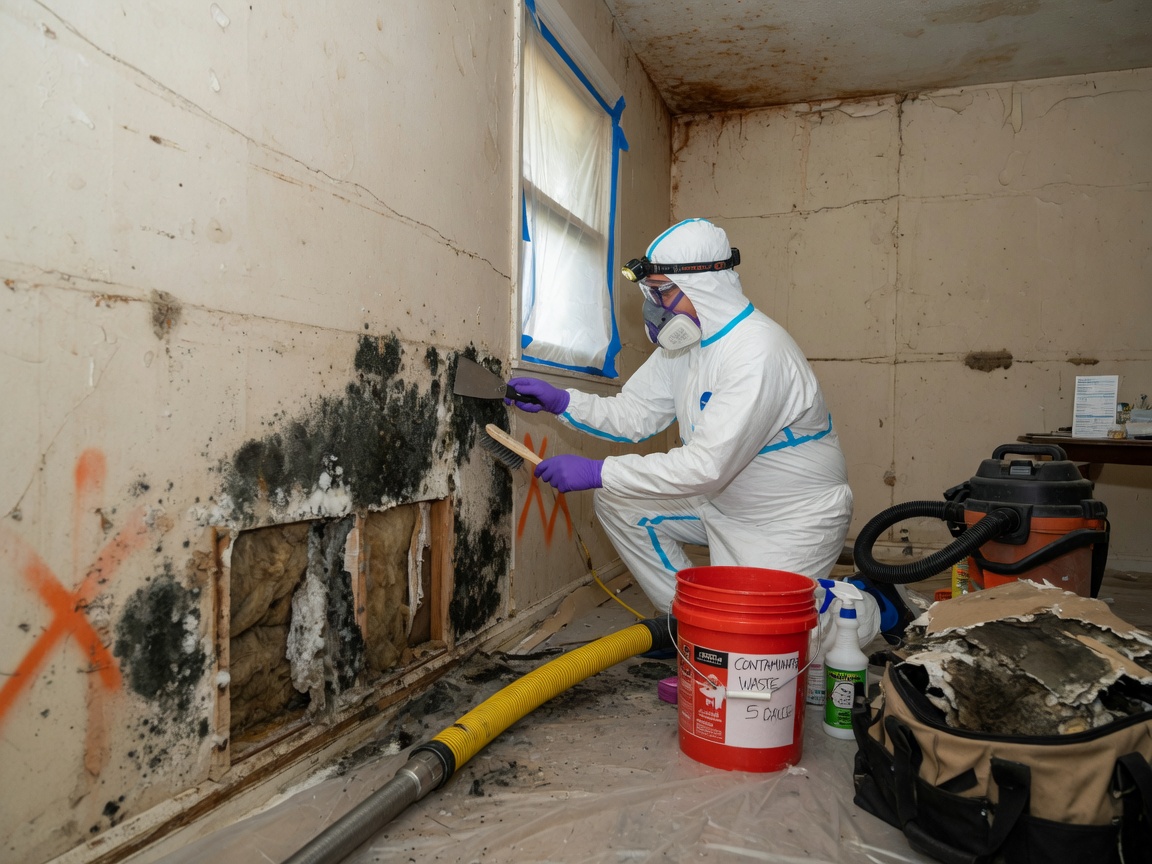
"Black mold" is a description of colour, not a species, and that confusion costs Shreveport homeowners money in both directions. Dozens of molds present as dark staining. The one people mean is usually Stachybotrys chartarum, a greenish-black mold with a distinctly slimy or wet appearance that grows only on cellulose materials — drywall paper, cardboard, ceiling tile, wood — that have been continuously wet for a week or more. It does not grow on a surface that merely gets humid.
What You Probably Have Instead
Most dark growth found in Shreveport homes is not Stachybotrys. Cladosporium is the most common dark mold in this climate and appears as olive to near-black spotting on window sills, bathroom surfaces, painted walls and HVAC components. Alternaria shows up in damp bathrooms and under sinks. Aspergillus niger produces black spotting that genuinely looks the part. All three are far more common here than Stachybotrys, and all three are removed the same way.
This matters because the species does not change the remediation method — containment, physical removal of porous material, HEPA filtration, antimicrobial after removal — but it absolutely changes the pricing you should accept. A contractor quoting a premium specifically for "toxic black mold" before any lab result exists is quoting on a guess. If the species genuinely matters to you, for a claim or a sale, confirm it with mold testing first. A surface swab is inexpensive and the lab names what is actually growing.
Where Stachybotrys Actually Turns Up Here
Because it needs sustained saturation rather than humidity, Stachybotrys in Shreveport tracks to specific failures: a supply line or drain leak inside a wall that ran for weeks, a roof leak that kept drywall and insulation wet through a rainy spring, an overflowing HVAC condensate pan soaking the plenum and surrounding material, or a crawl space that held standing water after the heavy rains north Louisiana receives.
The tell is the material. Growth on the paper face of drywall, on the back of cardboard-backed insulation, or on saturated subfloor sheathing is consistent with it. Growth on tile grout, a painted ceiling above a shower, or a window sill is almost certainly something else — those surfaces cycle wet and dry, which Stachybotrys cannot tolerate.
Removal, and Why Material Choice Decides the Scope
Porous material that has grown black mold comes out. Drywall, insulation, carpet pad, ceiling tile and cardboard cannot be cleaned to a reliable standard because the growth is inside the material, not on it — cleaning the face leaves the colony. Semi-porous material, mainly framing lumber and subfloor, can usually be saved: HEPA vacuuming followed by controlled abrasive cleaning where growth has penetrated the wood surface, then an EPA-registered antimicrobial after the physical removal rather than in place of it. Non-porous surfaces — glass, metal, sealed concrete, tile — clean up fully.
Containment is not optional on this work. Disturbing a colony aerosolizes far more spores than leaving it alone, which is exactly why cutting into black mold without negative air and HEPA filtration makes the house worse than it was that morning. The work area is sealed, held under negative pressure with HEPA exhaust, and the HVAC serving it is isolated so the system does not distribute what the demolition releases.
Health Questions, Answered Honestly
The claim that Stachybotrys causes bleeding lungs, memory loss or permanent neurological injury traces to a 1990s CDC investigation that the agency itself later retracted after finding the original link unsupported. Current CDC and EPA guidance is more measured: mold exposure commonly causes allergic and respiratory symptoms — congestion, coughing, wheezing, eye and throat irritation — and can be more serious for people with asthma, significant allergies, or compromised immune systems.
The practical conclusion is the useful one, and it is the same either way: all indoor mold growth should be removed and the moisture that caused it corrected, regardless of species. You do not need a scary lab name to justify the work, and you should not accept a scary lab name as justification for an inflated price.
Catching It Before It Becomes This
Stachybotrys needs sustained saturation, which means almost every case of it began as a water event nobody addressed in time. Under the ANSI/IICRC S500 standard, clean water reclassifies to contaminated within 24 to 48 hours of touching porous building material, and mold follows on roughly the same clock. If water is standing or a leak has just been found, emergency water extraction and water damage restoration are the right call today — drying the structure to a verified standard costs a fraction of removing drywall, insulation and framing later.
Where the water has already been sitting, the location decides the scope: crawl space, attic, bathroom, basement or HVAC and ductwork. Start with mold inspection and testing to map the extent, and close out with independent mold clearance testing.
Technician insight
If a contractor names "toxic black mold" before any lab result exists and prices accordingly, you are being quoted on a guess. In Shreveport the overwhelming majority of dark growth is Cladosporium or Aspergillus, not Stachybotrys, and the removal method is identical for all of them. A $200 swab protects you from a four-figure assumption — and the honest version of the advice is that it all needs to come out anyway, which is precisely why the species should not change the price.
Saturated Wall Cavity in Highland
A Highland homeowner found dark slimy growth on the back of baseboard after a supply line behind a kitchen wall had been weeping for several weeks. The material and water history were consistent with Stachybotrys and a swab confirmed it. Moisture mapping showed saturation had travelled four feet further than the visible staining. Drywall and insulation came out to the mapped extent, the framing was cleaned and saved, the line was repaired and the cavity dried to a verified reading before rebuild.
Black Mold Removal Services We Offer
✓Black Mold Identification and Species Testing
Surface swabs and air samples analyzed by an accredited lab to name what is actually growing, so the scope and the price are based on a result rather than on the colour of the stain.
✓Wall Cavity Black Mold Removal
Targeted cut-out of drywall and insulation to a meter-verified extent where a supply or drain leak has kept the cavity saturated for weeks — the classic Stachybotrys scenario in Shreveport homes.
✓Contained Porous Material Removal
Removal and disposal of drywall, insulation, carpet pad and ceiling tile, which cannot be cleaned reliably because the growth sits inside the material rather than on its face.
✓Framing and Subfloor Salvage Cleaning
HEPA vacuuming and controlled abrasive cleaning of structural lumber where growth has penetrated the wood, saving the framing rather than replacing it.
✓Negative Air Containment
Sealed work area under negative pressure with HEPA exhaust and the serving HVAC zone isolated, since disturbing a colony releases far more spores than leaving it undisturbed.
✓Post-Flood Black Mold Response
Rapid containment and structural drying after the heavy spring rains north Louisiana receives, when sustained saturation creates the one condition Stachybotrys actually needs.
✓Insurance and Real Estate Documentation
Written findings with species results, moisture readings, photographs and cause, structured for a carrier or a disclosure where buyers are asking about past water intrusion.
Black Mold Removal Cost in Shreveport, LA
| Service | Typical Range | What Affects It |
|---|---|---|
| Small Localized Area — Under 10 sq ft | $600–$1,200 | Single wall section or closet in accessible space |
| Species Testing — Surface Swab | $150–$300 | Lab confirmation of what is actually growing, before demolition |
| Wall Cavity Removal — Single Room | $1,500–$3,500 | Drywall and insulation out to the mapped moisture extent |
| Whole-Room or Multi-Area Project | $3,500–$6,500 | Larger homes where water travelled through several cavities |
| Framing and Subfloor Abrasive Cleaning | $1,200–$3,000 | Saving structural lumber where growth penetrated the wood |
| Independent Clearance Testing | $200–$650 | Arranged through a separate assessor, as Louisiana law requires |
Ranges are typical for Shreveport, LA and confirmed with an exact written quote before any work starts.
How it works
- 1
Identify the Material and the Water History
Establish what the growth is on and how long it has been wet. Growth on saturated drywall paper or subfloor is consistent with Stachybotrys; growth on grout or a window sill is almost certainly a different mold.
- 2
Test Before Assuming
Where species matters for a claim or a sale, take a surface swab for lab analysis. It is inexpensive and it prevents paying a premium for an assumption.
- 3
Map the Moisture Extent
Meter readings across walls, floor and ceiling define how far the saturation actually travelled, so demolition is sized to the water rather than to the visible staining.
- 4
Containment and HVAC Isolation
Seal the work area, establish negative pressure with HEPA exhaust, and isolate the HVAC zone so demolition does not distribute spores through the house.
- 5
Remove Porous, Clean Semi-Porous
Bag and dispose of drywall, insulation and other porous material; HEPA vacuum and abrasively clean framing and subfloor where growth penetrated the wood.
- 6
Treat After Removal
Apply an EPA-registered antimicrobial once physical removal is complete — after, never instead of, because treating over growth is cosmetic.
- 7
Correct the Source and Dry
Repair or coordinate repair of the leak, roof, condensate line or drainage that caused sustained saturation, then dry the structure to a verified moisture content.
- 8
Document and Verify
Deliver photographs, readings, species results and a written scope, with independent clearance testing arranged through a separate assessor where verification is needed.
Pricing
Black mold removal in Shreveport starts around $600 for a small contained area. Scope is driven by how much porous material must come out, which depends on how far the water travelled — not on the species.