
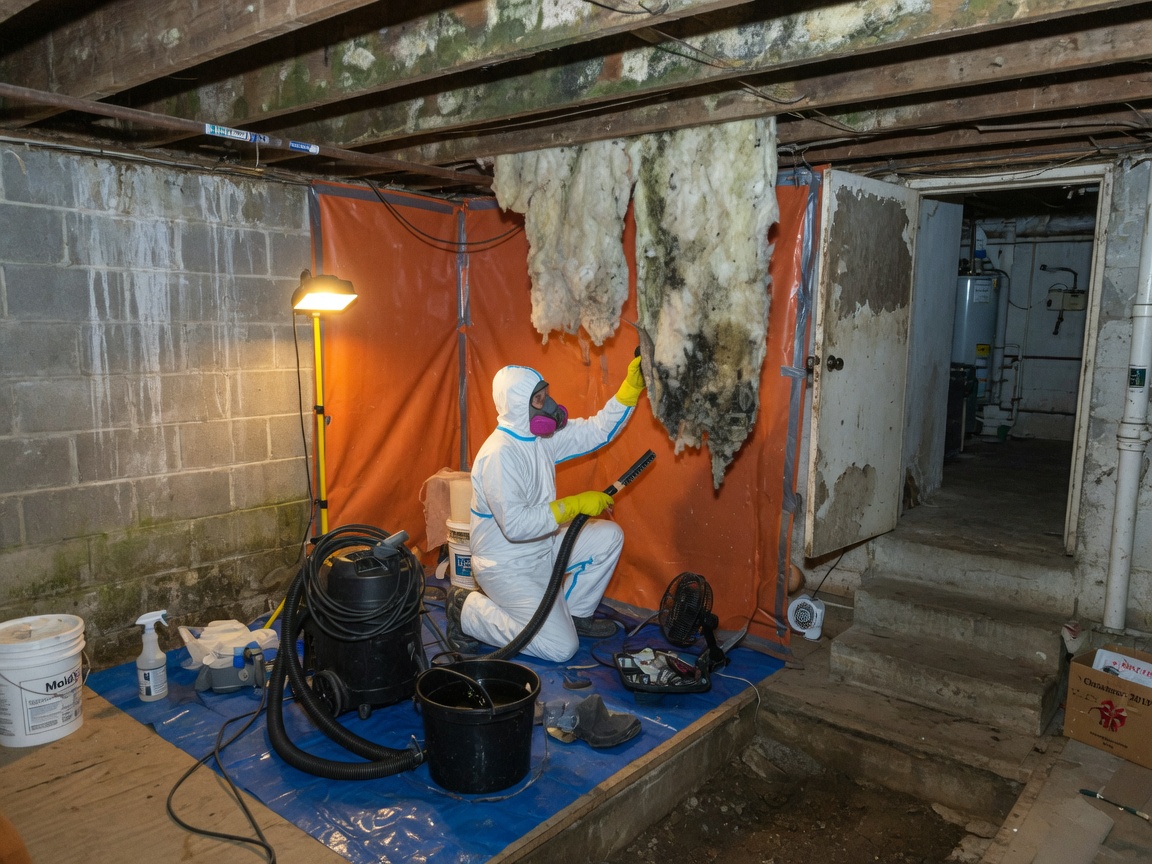
True basements are uncommon in Shreveport. The high water table across Caddo Parish made full excavation impractical for most of the city's housing stock, so what people here call a basement is usually one of four things: a partial basement added under part of the footprint, a below-grade addition or converted garage, a sunken utility or storm room, or a split-level lower floor sitting a few feet below grade. All four share the same vulnerability, and it is different from the vulnerability of a crawl space. If the space under your house is an unfinished dirt-floor area on brick piers, the crawl space mold removal page covers that work instead.
Water Comes Through the Wall, Not the Air
In a crawl space the problem is humid air condensing on cool framing. In a below-grade room the problem is liquid water under pressure. Soil against a basement wall holds water after rain, and on Caddo Parish's heavy clay it holds it for days. That standing head of water pushes against the wall and finds the three places concrete and block reliably leak.
Cold joints come first — the seam where the floor slab meets the wall, or where a later addition was poured against existing foundation. These joints were rarely waterproofed properly on additions, and they weep during the mild winter rains rather than during summer storms, which is why the staining often appears in a season nobody associates with water.
Second is the block itself. Concrete masonry units are hollow and porous; water entering at the footing wicks upward through the cores and emerges as efflorescence and damp patches well above the actual entry point. Third is penetrations — utility entries, old coal or fuel chutes, abandoned pipe sleeves and window wells that drain toward the house rather than away.
Why Finishing Materials Fail First
The growth in a Shreveport basement is almost always on what was added to the walls, not on the structure. Paper-faced drywall against a below-grade block wall, furring strips, fiberglass batt in the stud bays, carpet and pad, and the back of wood panelling are all cellulose-rich and all sit exactly where moisture arrives. The concrete itself does not feed mold; the drywall bolted to it does.
That shapes the scope. Affected drywall is removed to a measured height above the damp line — commonly 18 to 24 inches, confirmed by meter readings rather than guessed — along with insulation, carpet pad and any trim that has wicked. Masonry is cleaned and treated. Rebuild then uses materials appropriate to a below-grade wall: mold-resistant or cement board, rigid rather than fibrous insulation, and a finish that can dry in both directions.
Correcting the Source, in the Right Order
Basement work has a clear hierarchy, and taking it out of order is why so many of these jobs recur. Exterior water management comes first and is the cheapest: gutters discharging well away from the foundation, downspout extensions, grading that falls away from the wall, and window wells that drain. A surprising share of Shreveport basement moisture is solved at this stage alone, because the lots are flat and the water simply has nowhere to go.
Second is the drainage path — a perimeter drain tied into existing grading where fall allows it, or an interior drain and sump where it does not. Third is sealing: penetrating sealers and cold joint treatment, which work only once the water volume has been reduced, never as a substitute for reducing it. Fourth is humidity control, because a below-grade room in this climate will sit above 60% relative humidity on its own even with no leak at all.
Selling a sealer first and a sump second, with no attention to gutters and grade, is the most common pattern in a quote that will not hold.
Technician insight
Check the gutters before you quote a sump. Shreveport lots are flat, and a downspout discharging two feet from a below-grade wall will load that wall with more water every storm than groundwater does all year. The sequence that holds is exterior water first, drainage second, sealing third, humidity fourth — and a quote that opens with a sealer and a sump while ignoring the gutters and the grade is a quote for work that comes back.
Below-Grade Addition Off Line Avenue
A below-grade den added under the rear of a Shreveport home showed staining along the base of two walls every winter but stayed dry all summer. Moisture mapping traced it to the cold joint where the addition slab met the original foundation, loaded by a downspout discharging at the corner. Drywall came out to 20 inches, the masonry was cleaned and treated, the downspout was extended and the grade corrected, and the joint was sealed afterward. The following winter the walls read dry.
Basement Mold Removal Services We Offer
✓Below-Grade Wall Mold Removal
Removal of affected drywall, furring, insulation and trim to a meter-verified height above the damp line, with cleaning and treatment of the masonry behind it.
✓Cold Joint Investigation and Sealing
Locating weeping at the slab-to-wall seam and at additions poured against existing foundation — the leak that shows up during mild winter rains rather than summer storms.
✓Block Wall Moisture Tracing
Following water that enters at the footing and wicks upward through hollow masonry cores, emerging as efflorescence well above the real entry point.
✓Exterior Water Management
Gutters, downspout extensions, grading and window well drainage — the first and cheapest correction, and the one that resolves much of the basement moisture on Shreveport's flat lots.
✓Perimeter and Interior Drainage
A perimeter drain tied into existing grading where fall allows, or an interior drain and sump where it does not, installed after exterior water has been reduced.
✓Post-Flood Below-Grade Drying
Extraction, structural drying and antimicrobial treatment after the heavy spring rains north Louisiana receives, with readings logged to a verified dry standard.
✓Below-Grade Humidity Control
Dehumidification sized for the space, since a below-grade room in a humid subtropical climate will hold above 60% relative humidity on its own even with no active leak.
Basement Mold Removal Cost in Shreveport, LA
| Service | Typical Range | What Affects It |
|---|---|---|
| Below-Grade Inspection and Moisture Mapping | $175–$325 | Wall, slab joint and penetration assessment with readings |
| Basement Mold Removal — Per Wall Section | $800–$1,600 | Depends on damp line height and how much drywall comes out |
| Basement Mold Removal — Full Room | $1,500–$3,000 | All affected finishes removed, masonry cleaned and treated |
| Exterior Water Management | $300–$1,200 | Downspout extensions, grading correction, window well drainage |
| Interior Drain and Sump | $2,500–$6,000 | Where lot fall will not support a gravity perimeter drain |
| Cold Joint and Penetration Sealing | $400–$1,500 | After water volume has been reduced, not as a substitute |
| Dehumidifier — Supplied and Set | $1,200–$2,400 | Sized to the space, condensate routed to drain or exterior |
Ranges are typical for Shreveport, LA and confirmed with an exact written quote before any work starts.
How it works
- 1
Assess and Identify the Entry Point
Inspect walls, slab-to-wall joints, penetrations and window wells, with moisture readings mapped across the wall to locate where water is actually entering rather than where it is showing.
- 2
Check the Exterior First
Walk the gutters, downspouts, grade and window wells before scoping anything interior. On flat Shreveport lots this is frequently where the problem starts and the cheapest place to fix it.
- 3
Containment
Seal the work area with negative air and HEPA filtration so demolition does not carry spores into the floors above.
- 4
Remove Affected Finishes
Take out drywall, furring, insulation, carpet pad and trim to a meter-verified height above the damp line, and haul the material away.
- 5
Clean and Treat Masonry
HEPA vacuum and clean exposed concrete and block, then apply an EPA-registered antimicrobial after physical removal is complete.
- 6
Correct Water in Order
Exterior water management, then the drainage path, then sealing cold joints and penetrations — sealing only after the water volume has been reduced, never instead of reducing it.
- 7
Dry and Control Humidity
Dry the structure to a verified moisture content and set dehumidification sized for the space to hold it under 60% relative humidity.
- 8
Document and Rebuild Guidance
Deliver photographs, moisture readings and a written scope, with rebuild specified in materials suited to a below-grade wall. Reconstruction quoted separately.
Pricing
Basement mold removal in Shreveport typically runs $500 to $3,000 depending on wall area and how much finishing material has to come out. Drainage and exterior water correction are scoped separately.